Jump to:
When installing a new shed, it may be tempting to place it right at the edge or up against your fence to maximise your outdoor space. Yet doing so could not only be legally risky but also cause damage to your building.
Here’s what you need to know, with FAQs that are also helpful if you’re getting new garden storage.
What’s the Minimum Distance Between Shed and Fence?
In England, if any part of a shed is within 2 metres of a boundary, its overall height must not exceed 2.5 metres, otherwise it will require planning permission.
The exemptions from planning permission for a shed are detailed in the Town and Country Planning (General Permitted Development) (England) Order 2015. This law often applies when the shed falls within the two-metre rule. Meaning, any part exceeding 4 metres in height (3 metres if the roof is not dual pitched) or with eaves exceeding 2.5 metres.
Remember, these are just guidelines, and just because you’re within the thresholds on height and distance, doesn’t mean other restrictions don’t apply. You can contact your Local Planning Authority (LPA) for help.
An extra note on wooden sheds: as one of the UK’s leading manufacturers, we advise that wooden buildings should have at least 24 inches of space around all sides, for airflow and maintenance access. This is a shed care matter rather than a legal requirement — it helps to prevent moisture-related issues in wooden structures.
Do Wooden Sheds Need to Meet Fire Safety Regulations?
Some wooden sheds are affected by fire safety rules under UK Building Regulations. This mainly affects those over 15 square metres placed close to a property boundary. Compliance helps reduce the risk of fire spreading to neighbouring properties.
If that applies to your shed, Building Control has the authority to enforce rules to minimise fire spread. They might require you to:
- Install fire-resistant walls on the boundary side
- Limit openings or windows on the boundary side
- Treat the timber with fire-retardant coating
If they don’t raise any concerns, you wouldn’t need to take these steps, but it’s always best to confirm with them before installation. Or, to be on the safe side, you can simply position your shed at least 2 metres (6 ft.) or more from the boundary.
Here’s the easy to remember version:
- Under 15m² (no sleeping): typically no Building Regs application.
- 15–30m² (no sleeping): typically exempt only if it’s 1m+ from boundary or substantially non-combustible.
- Over 30m² or sleeping accommodation: Building Regs apply.
These regulations apply even if planning permission isn’t needed.
Why Can a “Too Close” Minimum Distance Between Shed and Fence Lead to Issues?
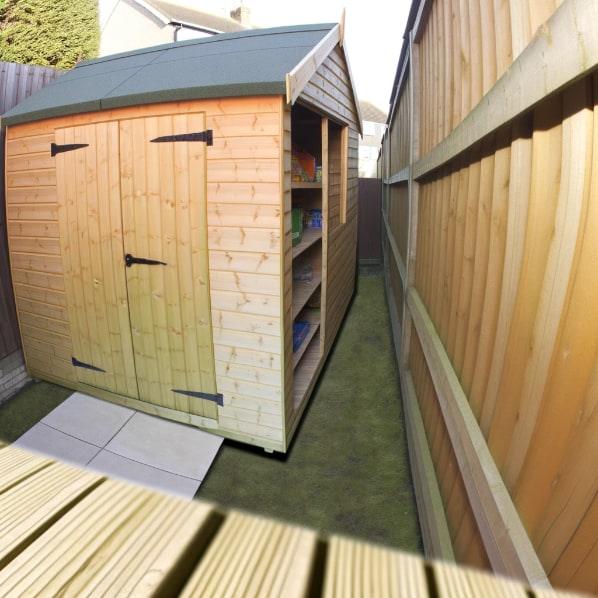
Now, consider if it’s your neighbour’s fence rather than your own. You might be tempted to put your shed nearby, especially if you get along well with them. Although not required, it’s advisable to discuss the matter with them.
Consulting them about how the placement may impact their garden shows courtesy. Failure to do so could lead to penalties or legal issues, such as fines or being required to move the shed. Maintaining positive relationships with neighbours also avoids disputes. Learn more about laws on fencing between neighbours.
Too close to the fence will prevent the wooden storage from breathing. This can result in shed condensation, mould build-up, and limited access. For instance, it would make it harder for you to get around the back and side of the shed to apply its annual wood treatment.
Adhere to local regulations and place your shed appropriately. Doing so will not only save time and money but also keep your neighbours happy.
What Are the Rules and Regulations Apply in the UK?
Homeowners can build a shed without permission from their local council. However, there are some specific rules, including how close a shed can be to a fence. In some cases, LPAs will have specific regulations on the minimum distance. Do your research and adhere to these rules before construction if this applies to your area.
If there aren’t any specific rules for your area, you can use the guidelines outlined above. Keeping at least 1 metre of space will give you room for maintenance and future expansion. With this in mind, you should have no trouble placing a shed exactly where you want it!
Round-up
It’s important to know the rules on minimum distance between shed and fence requirements. Following these helps you avoid problems with the law and neighbour disputes. Just make sure to check the regulations in your area and talk to your neighbours if needed. This way, you can enjoy your shed and fence without any worries.
We offer a range of garden sheds with heights not more than 2.5 metres. You can position one to a fence without the concern of planning permission.
If you have any further questions, contact us and don’t hesitate to call us at 01909 768840. For more positioning tips, read this next: Things to Consider When Positioning Your Shed